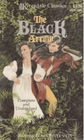
 Riverdale Classics, $3.50, ISBN 1-85534-509-9
Historical Fiction, 1990 (Reissue)

Let’s be fair to Robert Louis Stevenson up front. The poor man was seriously ill when he wrote The Black Arrow, and by his own admission, not particularly inspired. Bills had to be paid, the Victorian public demanded serialized tales of daring-do, and so he sat down and cranked out a medieval adventure whether his muse felt like it or not. And boy, can you tell.
Though the setting screams of swashbuckling promise — secret societies, the Wars of the Roses, masked avengers, young heirs on the run — what we actually get is a dry, tedious trudge through forests, castles, and ye olde conversation so stilted you could crack a tooth on it.
The story stars our hero young Dick Shelton, a lad whose defining personality trait is… well, being Dick Shelton. After discovering that his guardian Sir Daniel Brackley is a treacherous scoundrel and probable murderer of Dick’s father, he throws in his lot with The Black Arrow, a vigilante band of forest outlaws bent on revenge.
Along the way he rescues a plucky lass named Joanna Sedley (incognito in boy’s clothes because Victorian adventure trope checklist) and resolves to make things right, claim his inheritance, and marry the girl.
In theory, it’s a rip-roaring yarn. In practice, it feels likeMr Stevenson wrote it while half-dozing off, waking up only to add another “nay, good sirrah” or “by’r lakin!” every few pages.
Credit where it’s due: the setting has promise. Medieval England is always good for a swordfight or two, and if you squint, you can see the bones of a solid adventure story here.
There’s also a secret society with a cool name (the Black Arrow), even if they spend most of their time lurking around the woods like underpaid extras from a Robin Hood pantomime.
It also contains what might be literature’s earliest known example of a woman cross-dressing solely for plot convenience, so points for historical cliché bingo.
However, the minuses… where do we begin?
Mr Stevenson, bless him, tried to write in faux-medieval English. The result reads like someone whose only exposure to the Middle Ages was a single bad production of Henry IV, Part 1 at the local playhouse. Every conversation sounds like a tavern brawl between two thespians who won’t drop character.
Dick Shelton is the human equivalent of a damp tea towel. He starts the story as a plucky youth and ends the story as a slightly older, equally plucky youth. No wisdom gained, no hard lessons learned, just a few sword nicks and a betrothed lass for his trouble.
Speaking of the lass, Joanna Sedley is so one-note you’d think she was composed for a kazoo. Her main functions are to be disguised as a boy for the bare minimum plot mileage and to gaze adoringly at Dick, whose charisma could be safely stored in a thimble with room to spare.
As for the reader’s emotional investment, there isn’t any. You don’t care if Dick reclaims his inheritance. You don’t care if Sir Daniel gets his comeuppance. You barely remember who half these people are by the time the next chapter starts. It’s like watching someone else’s LARP campaign unfold via a third-hand transcript — technically adventurous, but emotionally barren.
The Black Arrow is proof that even literary greats have off days (or off serials). The ingredients for a cracking adventure are all here, yet it somehow manages to be both overwrought and underwhelming. The author himself later dismissed it as “tushery,” and reader, he was right.
If you’re craving Robert Louis Stevenson at his best, stick to Treasure Island, Kidnapped, or even Strange Case of Dr Jekyll and Mr Hyde. If you’re craving a medieval romp, go find a Robin Hood retelling that doesn’t sound like it was written in a Renaissance fair’s lost and found.
As for The Black Arrow, it’s best left to completists, masochists, and students punished with 19th-century lit assignments.