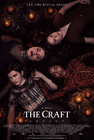
 Main cast: Cailee Spaeny (Lily Schechner), Gideon Adlon (Frankie), Lovie Simone (Tabby), Zoey Luna (Lourdes), Nicholas Galitzine (Timmy Andrews), Michelle Monaghan (Helen Schechner), and David Duchovny (Adam Harrison)
Director: Zoe Lister-Jones

When Jason Blum decided that The Craft, arguably one of the most endearing cult classics about witches and witchcraft gone wrong, needed a sequel that nobody asked for, one could sense the impending disaster from miles away. Like a dark cloud gathering on the horizon, The Craft: Legacy arrived in 2020 with all the creative enthusiasm of a mandatory corporate retreat.
The original 1996 film had a rawness to it, a genuine teenage angst married to genuine consequences. It understood that power without wisdom leads to corruption, that teenage girls could be both victims and villains, and that sometimes the scariest thing in a horror movie is watching someone you care about lose themselves. It was messy, imperfect, but it had a beating heart beneath all the Goth makeup and inverted pentagrams.
The Craft: Legacy, by contrast, feels like it was assembled by a committee that had only read the Wikipedia summary of the original while simultaneously trying to make the film as inoffensive and palatable as possible to the broadest demographic imaginable.
One suspects director Zoe Lister-Jones was brought onboard primarily because of her gender and sexual orientation — a cynical box-checking exercise rather than a genuine artistic choice. There’s no evidence in her filmography of any sustained interest in the horror genre, past or future, and it shows in every frame of this bloodless, toothless affair.
The plot follows Lily, a teenage girl who moves to a new town with her mother and her mother’s new boyfriend, only to discover she has magical powers and falls in with a coven of young witches. If that sounds familiar, it’s because the film seems content to trace the original’s outline without understanding what made it work.
The new coven, diverse in all the ways a 2020 studio film demands, practices a kinder, gentler witchcraft. They use their powers to fight toxic masculinity, empower themselves, and generally behave like they’re attending a particularly woke summer camp rather than dabbling in forces beyond their comprehension.
Gone is any sense of danger or transgression.
The original film understood that witchcraft, for teenage girls in a repressive culture, represented forbidden power — thrilling precisely because it was dangerous.
This sequel turns magic into a self-help seminar with better special effects. When these girls cast spells, you half expect them to follow up with a group hug and a discussion about their feelings. The film is so terrified of depicting its young women as anything other than flawless victims of patriarchy that it strips them of agency, complexity, and interest.
The movie’s moral cowardice is perhaps best exemplified in its treatment of Lily’s use of magic to coerce Timmy into loving her, which is a clear violation of consent that the film initially presents as romantic wish-fulfillment. You’d think this would be a perfect opportunity to explore concepts of consent and the ethics of magical manipulation, especially given how relentlessly preachy the film is about every other social issue.
But no — the film ultimately and conveniently blames the consequence of this magical assault on the evil straight white male villain, absolving Lily of any responsibility for her voluntary decision to essentially mind-rape someone into loving her.
It’s a staggering abdication of moral complexity, taking what could have been a genuinely interesting exploration of power and consent and reducing it to yet another example of how women can do no wrong and men are the source of all evil. The original film would have made Lily pay for such a transgression. This one gives her a free pass and a participation trophy.
The performances are uniformly bland, hampered by dialogue that sounds like it was generated by an algorithm trained on Tumblr posts and motivational Instagram quotes. David Duchovny shows up as the villainous stepfather, and even he can’t inject any real menace into the proceedings as his character less a genuine threat than a cardboard cutout labeled “Toxic Masculinity” in bold letters.
Most damning is the film’s complete abandonment of horror as a genre. There are no scares here, no sense of dread or unease, no moments that linger in your mind after the credits roll. It’s less a horror film than a young adult drama with occasional magical flourishes, as if someone had taken The Sisterhood of the Traveling Pants and added a few glowing hands.
The climax arrives with a cameo that feels less like a satisfying narrative choice and more like a desperate plea: “Remember the original? Wasn’t that good? Please like us!” It’s the cinematic equivalent of a reunion tour by a band that’s lost all its original members except one, banking entirely on nostalgia while delivering nothing of substance.
The Craft: Legacy ultimately feels like a film terrified of its own premise. It wants the cultural cachet of being associated with a beloved cult classic, but it refuses to engage with what made that original film resonate with the audience. It wants to be edgy and transgressive, but it also wants to ensure nobody could possibly be offended. It wants to be about teenage witches, but it strips away the danger, the darkness, and the genuine exploration of power and its corrupting influence.
The result is a film that exists purely as a corporate product — carefully focus-grouped, thoroughly sanitized, and utterly forgettable. It’s the kind of sequel that makes you appreciate the original even more, if only by demonstrating how difficult it is to capture lightning in a bottle twice.
Two oogies.