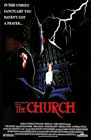
 Main cast: Hugh Quarshie (Father Gus), Tomas Arana (Evan), Barbara Cupisti (Lisa), Antonella Vitale (The Bridal Model), Giovanni Lombardo Radice (Reverend Dominic), and Asia Argento (Lotte)
Director: Michele Saovi

The Church, or La Chiesa if you want to show off your film snob cred, occupies a unique position in Italian horror history as the rare film that almost made sense. It frankly threw off half its target audience who came expecting the usual delirious nonsense that made 1980s Italian horror so wonderfully unhinged.
What we got instead was a movie caught between wanting to be a legitimate supernatural thriller and maintaining its pedigree as the spiritual successor to the Demons franchise – like watching someone try to perform Shakespeare while wearing a Halloween costume.
The production history of The Church reads like a masterclass in how movies get made through a combination of compromise, creative disagreements, and possibly some very heated phone calls. Originally conceived as Demons 3, the story was supposed to feature passengers stranded on a demon-infested island after a plane crash, which sounds like exactly the kind of gloriously bonkers premise that Italian horror does best.
Then someone apparently looked at the budget and said, “You know what’s cheaper than a plane crash and a tropical island? A single church location with some basement sets.” Thus, our demon island became a Gothic cathedral with spooky catacombs.
Lamberto Bava allegedly stormed off in a huff when this decision was made, though Dario Argento later claimed the whole Demons 3 thing was just Mr Bava’s wishful thinking. Michele Soavi stepped in to replace Mr Bava, insisting he and Franco Ferrini improved the script’s “sillier bits” — which raises fascinating questions about what the original version must have looked like if this was the refined version.
While Dario Argento had minimal actual involvement in the production beyond graciously allowing his name on the credits, his daughter Asia gets a mysteriously prominent role despite her character being about as essential to the plot as a chocolate teapot. She appears sporadically throughout the film like a well-connected ghost, only to emerge as the final girl by virtue of being conveniently absent during most of the actual horror.
It’s a fascinating study in how nepotism works in Italian cinema, as she gets top billing for what amounts to an extended cameo, while the actual protagonists do all the heavy lifting of moving the plot forward before presumably heading off to update their resumes.
The plot is straightforward enough: a Gothic cathedral sits atop catacombs filled with the mass grave of alleged devil worshipers, slaughtered by Teutonic knights who then demonstrated their strategic genius by building a popular worship destination directly over the evil they were trying to contain. It’s like putting a shopping mall on top of a nuclear waste site and then acting surprised when people start glowing.
New librarian Evan arrives, immediately begins a romance with fresco-touching artist Lisa, and naturally ignores every warning about not exploring the basement because apparently “DON’T GO IN THE CURSED CATACOMBS” translates to “DEFINITELY CHECK OUT THE CURSED CATACOMBS” in Horror Movie Character language.
The film is surprisingly restrained by Italian horror standards, focusing more on atmospheric dread than the elaborate gore set-pieces that made films like Suspiria and Deep Red legendary.
However, the central romance between Evan and Lisa serves as a masterclass in how to drain all energy from a horror film by focusing on two characters with all the romantic chemistry of a wet paper bag. Their courtship unfolds with the passion of a tax preparation seminar, made worse by dialogue that sounds like it was translated through several languages by someone who learned English exclusively from instruction manuals. The fact that they turn out to be more plot devices than actual protagonists makes all this romantic focus feel like the world’s most elaborate red herring.
In spite of this, The Church was considered genuinely shocking and gory upon its 1989 release, which says something fascinating about how our tolerance for cinematic mayhem has evolved. Watching it today feels like examining a historical artifact. You can intellectually appreciate what made it transgressive at the time while wondering what exactly had audiences clutching their pearls.
Where it does succeed is in creating genuinely unsettling atmosphere. The Gothic cathedral setting provides natural grandeur and menace, while the musical score delivers the kind of haunting ecclesiastical dread that makes you question every church visit you’ve ever made. The set pieces work beautifully when they’re allowed to breathe without being interrupted by wooden romance or exposition dumps.
Ultimately, Michele Soavi represents something of a bridge between the gonzo excess of classic Italian horror and more character-driven storytelling, which makes The Church feel like a fascinating experiment that doesn’t quite work. He’s clearly trying to salvage a script that originated from two legendary names who, bless their hearts, were never particularly concerned with narrative coherence throughout their careers.
The result feels like watching a talented filmmaker trying to make sense of source material that was never designed to make sense — admirable but ultimately missing the beautiful madness that made Italian horror so distinctive in the first place.