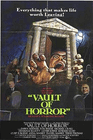
 Main cast: Dawn Addams (Inez), Tom Baker (Moore), Michael Craig (Maitland), Denholm Elliott (Lawrence Diltant), Glynis Johns (Eleanor Critchit), Edward Judd (Alex), Curd Jurgens (Sebastian), Anna Massey (Donna Rogers), Daniel Massey (Harold Rogers), Terry-Thomas (Arthur Critchit), Robin Nedwell (Tom), Geoffrey Davies (Jerry), Terence Alexander (Fenton Breedley), Ishaq Bux (The Fakir), John Forbes-Robertson (Wilson), Tony Hazel (The Voodoo Man), Jasmina Hilton (Indian Girl), Maurice Kaufmann (Bob Dickson), Sylvia Marriott (Mrs Breedley), Arthur Mullard (The Gravedigger), Michael Pratt (Clive), Marianne Stone (Jane), and John Witty (Arthur Gaskill)
Director: Roy Ward Baker

Vault of Horror is also known as The Vault of Horror and Tales from the Crypt II, because apparently nobody could agree on what to call this thing. This isn’t that eyebrow-raising, as some horror movies, especially the Italian ones, have three to five different titles.
Whatever one chooses to call it, this 1973 film from Amicus Productions gives us a fascinating glimpse into what passed for sophisticated horror entertainment back when Richard Nixon was president and everyone thought shag carpeting was the height of interior design.
Now, Amicus Productions was basically the horror anthology factory of its day, churning out these segmented scare-fests with the reliability of a German train schedule. And don’t you dare laugh at the cast – these people had actual credentials! Just check that cast listing and try not to be impressed. It’s like finding out your local community theater somehow landed half of Broadway for their production of Our Town.
Here’s where things get confusing in that special way that only 1970s British horror can achieve: this movie called Vault of Horror is actually adapted from Tales from the Crypt comics, with one story thrown in from Shock Suspenstories for good measure. Why call it Vault of Horror then? It’s like ordering a cheeseburger and getting a ham sandwich— technically food, but not what was advertised.
The framing device is delightfully standard: five guys get trapped in an elevator that mysteriously deposits them in a basement lounge that looks like it was decorated by someone who thought Victorian funeral parlors needed more ambiance. The elevator door slams shut like a mousetrap, leaving our protagonists with nothing to do but settle in for drinks and nightmare sharing. It’s basically group therapy for the supernaturally screwed, which is probably more effective than most actual therapy, considering these guys are all dead.
First up is Midnight Mess, which serves up a delicious slice of meta-horror with a side of family dysfunction. The segment stars real-life siblings Daniel and Anna Massey, and according to Anna’s autobiography, they got along about as well as oil and water in real life.
So, when Daniel’s character Harold murders Anna’s character Donna for her inheritance, you can practically feel the genuine sibling rivalry crackling through the screen.
Harold is so obsessed with his homicidal agenda that he completely misses the fact that he’s wandered into Vampire Central Station, where the locals have bigger teeth than a saber-toothed tiger and drink their dinner from necks instead of bottles.
The story itself is solid, and there’s a genuinely wicked ending that was too spicy for American audiences – because apparently, we could handle murder but drew the line at whatever British people consider shocking. The vampires sport fangs so comically oversized they look like they raided a novelty store’s Halloween clearance section, and their “blood” looks suspiciously like orange Kool-Aid, but hey, it’s a strong opening act.
Then we hit our first speed bump with The Neat Job, which gives us Arthur, a perfectionist so insufferable he makes Sheldon Cooper look laid-back. This walking embodiment of obsessive-compulsive disorder marries his friend’s daughter Eleanor — who looks old enough to be collecting social security, making her father approximately Methuselah — because he’s rich and apparently has run out of other hobbies.
Eleanor commits the cardinal sin of being human in Arthur’s sterile hellscape of a home, failing to follow his countless rules that would make a military academy seem relaxed. This should be genuinely disturbing psychological horror about domestic abuse and control, but instead it’s played for laughs like a sitcom where the laugh track broke. Most viewers will spend the segment wondering if Arthur deserves his fate or why Eleanor didn’t just burn the house down and flee to Mexico.
This Trick’ll Kill You is where things really go off the rails, and not in a good way. A magician and his wife murder a woman to steal her magic rope because grand larceny is a reasonable career advancement strategy for struggling performers. The rope develops a mind of its own and goes full vigilante, leading to the most unintentionally hilarious showdown in horror history. Picture Sebastian the magician defending himself in slow motion against a rope that moves with all the menace of a sleepy garden snake, and you’ll understand why this segment works better as comedy than horror.
The whole thing feels about as culturally sensitive as a Colonial Williamsburg reenactment, with Indian characters so stereotypical they make old Westerns look progressive. It’s enough to make you cringe and stupid enough to make you laugh, which is probably not the emotional combination the filmmakers were aiming for.
Bargain in Death gives us an insurance scam plot where everyone betrays everyone else with the efficiency of a soap opera writing room. It’s basically filler material — the kind of story you tell when you’ve run out of actual ideas but still have twenty minutes of runtime to fill.
The protagonist Maitland could have avoided his entire predicament by asking himself one simple question: “Is getting buried alive really the best way to commit insurance fraud?” Clearly, critical thinking wasn’t his strong suit, which explains why he ended up in the supernatural penalty box with the rest of these moral failures.
Finally, we get Drawn and Quartered, which perks things up like a shot of espresso in a cup of decaf. This is classic Tales from the Crypt material – a morality tale about how being a terrible person eventually catches up with you, usually in the most ironic way possible.
Moore is a reclusive artist holed up in Haiti, where all bitter creative types went to brood. No thanks to the miracle of pre-internet communication, he doesn’t realize he’s been scammed by his representatives until a friend drops by with some devastating truth bombs. Turns out his art has been selling like hotcakes while his so-called friends told him it was moving about as fast as molasses in January, pocketing the difference for themselves.
Naturally, Moore turns to voodoo for revenge; apparently going to court wasn’t dramatic enough.
The kills are genuinely inventive and surprisingly gory despite special effects that look like they were created by an enthusiastic high school drama club. It’s the most genuinely horrific segment since the opener, proving that sometimes the old ways are the best ways.
So, does Vault of Horror hold up today? Well, that depends on your tolerance for camp and your appreciation for historical curiosities. The special effects have aged about as well as milk left in the sun, and the movie has a habit of cranking up the silly factor precisely when it should be going for genuine scares. But here’s the thing – the acting is surprisingly solid, the stories have genuine merit despite some questionable execution choices, and the first and last segments are legitimately worth your time.
This isn’t a must-watch movie, but it’s definitely a noteworthy one if you want to see how the horror genre has evolved. Despite the dated effects and occasional tonal disasters, the core concepts and ideas in these old anthologies sometimes put modern horror to shame. It’s a fascinating time capsule that reminds you that good storytelling can survive even the most ridiculous vampire fangs and the slowest-moving revenge rope in cinema history.