 Sasbadi, RM23.90, ISBN 978-983-77-4448-6
Education, 2025

Mention the SPM Bahasa Melayu paper and most candidates will cringe in fear over Kertas 1, the karangan (Bahasa Melayu for “composition”) paper. It has a reputation for being easy to get a pass, but super hard to get an A+ score because of the exacting conditions said to determine whether one’s compositions get that score or a “mere” good score.
Having said that, many so-called SPM Bahasa Melayu karangan reference books are not very useful, because more often than not, they just showcase some generic advice like read the instruction carefully and plan your content before showing off the authors’ collections of sample compositions. These samples would be handy if the candidate plans to memorize them in the hope that a similar topic comes up — and let’s be honest, a number of candidates especially those of weaker proficiency do that — but even that is not going to be of much use if the actual Kertas 1 doesn’t touch on a topic that the candidate has memorized a sample essay for.
Having said that, I’m reviewing Rahsia Karangan Cemerlang SPM — or Secrets of Outstanding SPM Compositions — because it’s tad different from your typical karangan reference books.
First, the Design
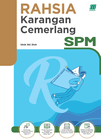
What’s with the cover? I know they want to streamline this book to look like it’s a spinoff from the 2025 Masterclass SPM reference books, but the cover looks unfinished. The brown bar that only covers the upper half of the cover and the weird green line below the “SPM” makes the cover look like the printer ran out of ink halfway.
Also, the inside pages sometimes present tips and advice in colorful flowcharts, which would be nice if they weren’t flowcharts without arrows. Inside, the boxed texts are stacked next to and on top of one another, and the eyes have to follow the numbers in each box to read things in the correct sequence.
Sometimes, it can get unnecessarily confusing.
For example, in a flowchart on page 4, Box 1 is divided into two different-colored columns of contrasting colors, and the number 1 is placed within the brighter column on the left. Hence, one’s eyes tend to skip the text in the right column of Box 1 after reading the left column, straight down to the box below that has the number 2 — and get confused as a result!
Still, this is just a minor quibble. The fact that the instructions and advice are presented in diagrams and flowcharts is a nice welcome from the usual walls of text present in other karangan reference books.
Now, the Content
I should point out that this book is not for candidates with lower proficiency in Bahasa Melayu. The title isn’t lying: it is about karangan cemerlang.
The author isn’t interested in teaching the fundamentals of writing Bahasa Melayu composition. In fact, the language used in this book makes it very clear what its intended audience is.
Here’s a typical sentence one would encounter in this book.
Berpedomankan tamsil, lagu dan irama berpisah tiada demikianlah pemimpin dan rakyat hendaklah mewujudkan sinergi dan kolaboratif demi maslahat negara.
If you are reaching for the dictionary to make sense of this sentence because you are not even sure whether it’s in Bahasa Melayu, this is definitely not the book for you!
(Still, FYI, after taking out all the unnecessary purple phrasing in that sentence, it basically means: “Like how a song and its melody cannot be separated, so too should leaders and the people work together in synergy for the good of the nation.”)
This is not how one writes for the purpose of communicating with the everyday layperson on the street, but you know who loves this kind of purple-hued writing? SPM Kertas 1 examiners!
Indeed, marks are allocated just for the “outstanding use of elegant phrasing”, and this is the kind of sentences candidates aiming to get that A will have memorized for that paper.
This is where this book stands out among others of its kind in the market. It drops phrases and words that would make those candidates that are well-versed in the language and determined to get that A shiver in joy as they get ready to memorize the phraseology and how it is used.
Even better, there is a distinct skew towards Arabic and Islamic leanings in the choice of Bahasa Melayu words and phrases used here, and this is a good thing because… well, every SPM candidate knows why; they just won’t say it out loud!
Therefore, SPM candidates that want to do super well in Kertas 1 of the Bahasa Melayu paper would very likely find this book to be their bible for getting that A+, especially if they don’t have a teacher to supply those “kosa kata dan ungkapan indah” needed to do well in the paper. Yes, this book also has a pretty nice list of those things too — not exhaustive, but let’s be real, how many are capable of memorizing an entire encyclopedia of idioms, similes, proverbs, and quotes anyway?
This book also offers some practical advice, such as how many isi penting one should include, whether it’s okay to exceed the word count and how many words if yes, and so forth. The advice is nothing that hasn’t been covered in many SPM Bahasa Melayu reference books, but the use of colors and diagrams to present these facts would make them easier to be taken note of and remembered.
Final Verdict
- If you are not so proficient in Bahasa Melayu, it’s best to invest in a good tuition teacher, preferably a Bahasa Melayu teacher that also marks the SPM paper or has some in on latest developments of the SPM Bahasa Melayu syllabus. If you have some extra cash after that, get Focus SPM: Bahasa Melayu; that book goes beyond the call of duty to give step-by-step guides and advice on how candidates with problems in grasping the fundamentals can still “get” what to do for the actual Kertas 1.
- However, if you are pretty proficient in writing decent to solid Bahasa Melayu karangan and want some help in being as bombastic, florid, and overwrought as can be — the key to doing cemerlang in this paper — then this book is pretty helpful in getting a head start. No shame in being kiasu if you get that A+ in the end!