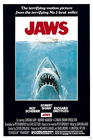
 Main cast: Roy Scheider (Chief Martin Brody), Robert Shaw (Quint), Richard Dreyfuss (Matt Hooper), Lorraine Gary (Ellen Brody), Murray Hamilton (Mayor Larry Vaughn), Carl Gottlieb (Harold Meadows), Jeffrey C Kramer (Deputy Leonard Hendricks), and Susan Backlinie (Chrissie Watkins)
Director: Steven Spielberg

Jaws turns 50 this year, which means it’s officially old enough to have watched every single one of its inferior offspring crashed and burned while maintaining its status as the undisputed champion of monster movies.
This is the film that taught Hollywood a valuable lesson: sometimes the best way to terrify audiences is with a mechanical shark that barely worked and a young director who had no idea he was about to change cinema forever.
Let’s start with the elephant in the room – or rather, the shark in the ocean. Jaws is responsible for both the greatest monster movie ever made and the most environmental damage caused by a single film. It gripped the world in such a frenzy that people became afraid to go to the beach, which would be merely amusing if it hadn’t also led to the unnecessary persecution and slaughter of actual sharks. Thanks, Hollywood! Nothing like a masterpiece with a body count that extends beyond the screen.
But the film’s cultural impact goes far beyond marine biology disasters. Jaws essentially wrote the playbook for modern horror, establishing tropes so fundamental that we barely notice them anymore:
- Susan Backlinie’s iconic opening scene created the template for every “attractive person makes poor life choices and pays the ultimate price” moment in horror history.
- Mayor Larry Vaughn became the patron saint of every politician who’s ever said, “We can’t possibly cancel the festival/close the beach/acknowledge danger because think of the economy!”
- “You’re gonna need a bigger boat” became the gold standard for understated badassery in the face of overwhelming odds.
- The film proved that the monster you don’t see is infinitely more terrifying than the one you do.
Also, the success of Jaws proved that audiences had an insatiable appetite for animals behaving badly, leading to a parade of increasingly ridiculous imitators. Suddenly every creature in the animal kingdom became a potential movie monster: alligators (Alligator), octopi (Tentacles), and so forth. Let’s not forget, although as hard as we try to, the increasingly awful sequels.
The story of is elegantly straightforward: a great white shark decides Amity Island looks like an all-you-can-eat buffet, and three men with varying levels of sanity decide to do something about it. Police Chief Brody (Roy Scheider) wants to close the beaches, marine biologist Hooper (Richard Dreyfuss) wants to study the problem, and shark hunter Quint (Robert Shaw) just wants to kill the damn thing. What follows is essentially “The Most Dangerous Game” if the game had teeth the size of dinner plates and absolutely no interest in fair play.
It’s a testament to Steven Spielberg’s direction that such a simple premise becomes a masterclass in tension, character development, and the fine art of making audiences afraid of vacation destinations.
Here’s the beautiful irony of Jaws: the mechanical shark worked about as well as a chocolate teapot, forcing Mr Spielberg to rely on suggestion, implication, and sheer directorial wizardry instead of showing off his rubber monster. What could have been a disaster became the film’s greatest strength, proving that sometimes the best special effect is the one you never see.
Steven Spielberg builds tension like a master architect, using everything from John Williams’s iconic score (those two notes that still make beachgoers nervous) to brilliant cinematography that turns every shadow in the water into a potential threat. There are no cheap jump scares here, no gratuitous “Gotcha!” moments – just relentless, methodical terror that builds to an explosive climax.
The famous scene where we finally see the shark in all its glory – emerging like a maritime nightmare – works precisely because we’ve spent the entire movie imagining something even worse. It’s a masterpiece of delayed gratification that modern horror directors should study like scripture.
As for the cast, let’s be honest: nobody remembers the human characters’ names except perhaps Quint, and that’s mainly because Robert Shaw delivers one of cinema’s greatest monologues about surviving the Indianapolis shark attacks. But here’s the thing: the acting is uniformly excellent, even if everyone involved knew they were essentially supporting players to a rubber shark that spent most of the movie broken.
Roy Scheider brings genuine everyman charm to Chief Brody, making him the perfect audience surrogate for landlubbers who suddenly find themselves in very deep water. Richard Dreyfuss manages to make marine biology seem both fascinating and urgent, which is no small feat. And Shaw’s Quint is the stuff of legend — a character so memorably unhinged that he makes Captain Ahab seem well-adjusted.
The entire cast elevates what could have been a simple monster movie into something approaching Shakespearean tragedy, if Shakespeare had written about municipal politics and marine predators.
Despite the shark’s technical shortcomings, every other aspect of the production is firing on all cylinders. The cinematography transforms the ocean from a vacation destination into a realm of primal terror. The editing creates rhythm and pacing that never lets up, building tension like a slowly tightening vice. Williams’ score is so iconic that those two notes have become shorthand for impending doom in popular culture.
The film moves with the inexorable momentum of its titular predator. Once it has you, it never lets go. Even nearly five decades later, Jaws never feels dated, never loses its edge, never stops being absolutely terrifying.
The bottom line is that Jaws isn’t just a great movie – it’s a cultural phenomenon that redefined what monster movies could be. Essential viewing for horror fans, film students, and anyone who wants to understand why sometimes the best special effect is the one that doesn’t work. Just maybe avoid watching it right before your beach vacation.