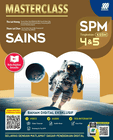
 Sasbadi, RM36.90, ISBN 978-983-77-3859-1
Education, 2024

As a subject, Science is available in Malaysia in both Bahasa Melayu and English.
However, candidates taking the SPM Pure Sciences subjects — Biology, Chemistry, Physics — do not have to take Science, so most candidates that do take this subject will be in the Humanities stream. Because nearly all of the subjects in that stream are taught in Bahasa Melayu, most teachers and candidates from that stream prefer to conduct Science classes in Bahasa Melayu.
Therefore, it makes sense that Sasbadi didn’t bother to publish the English version of Masterclass SPM: Sains since 2024.
They don’t bother publishing the English versions of their Pure Sciences reference books in 2025, however, so I wonder what the reason for that would be.
Anyway, this is why I am reviewing the Bahasa Melayu version of this reference book. The previous English version was published in 2023, and I can’t locate a copy of that anymore.
Authors
Ever since I’m told that the authors are toe and thumb, I can’t unsee it.
Still, these two authors have been around for a long time, and they are also the authors of two Science textbooks. So, they are legit.
Design
Like all other Masterclass SPM books, the design is impeccable, very impressive to a degree that I have never seen before in SPM reference books from other publishers.
The use of colors aside, this book is much wider than normal. This is because every page comes with a 6.5 cm-wide colored side bar that is used for annotations as well as a box for one to put in the date when they revised a certain chapter.
This side bar is fantastic because there is more than enough space to put in one’s own notes. In this case, one can write in new words one has learned and their meanings, advice and tips from elsewhere, URLs, and other details to make this the one-stop reference book for one’s revision needs.
The fact that one can jot down notes also makes this book the perfect vehicle for active learning, which research has found to be far more effective than just passive reading. With plenty of space to add in notes, illustrations, and even small mind maps, this book is designed for this very purpose, so much kudos to the people that did the design and layout.
Content
.. And it’s a good thing that this book has plenty of space to jot down notes, because just like with Masterclass SPM: Physics that is also by the same authors, this book covers just the fundamentals that are already in the textbook and barely steps past that.
There are some good uses of diagrams and illustrations, but for the most part, what one finds in the textbook is what one will find here.
Even then, descriptions of real-world applications are so frustratingly short, often reduced to just phrases in a table or flow chart, that some candidates may have problems extrapolating things into more detailed answers should they be asked about the topic in the actual SPM Sains exam.
Is it a good thing? Well, it can be if one wants to master the fundamentals enough to pass the exam or do slightly better than that. However, candidates that want to know a bit more beyond the textbook will have to invest in a different reference book.
On the flip side, the practice exams are more to the current types of questions asked in the actual exam, although not that current. There is still a preponderance of straightforward, not-so-KBAT questions all over the place when the actual paper has slightly more KBAT stuff than what this book would suggest.
Also, the answers provided at the back of the book can be suspect due to typographical errors. Nothing too major that will confuse people, but still, it makes the publisher and the authors appear careless.
In other words, Sasbadi really needs to update the content of some of their SPM reference books, including this one, because the content is showing its age. Instead of just slapping a new cover every year, why not take time to overhaul the whole thing? As it is, other publishers are overtaking Sasbadi because of this complacency on the part of this publisher.
Still, It’s Not That Bad
This is because the KBAT (Kemahiran Berfikir Aras Tinggi; High Order Thinking Skill or HOTS in English) questions in the SPM Sains paper aren’t that terrifying, in my opinion. There are some questions that ask candidates to analyze things or offer their deductions but judging from the actual papers from the last few years, these questions aren’t too difficult or too far out of the textbook realm.
The “pure” KBAT question, the compulsory question 11 in Paper 2, isn’t actually that KBAT in nature because it relies on how well the candidates have understood and memorized the experiments in their textbook.
You see, the subject doesn’t have a practical paper, so candidates are put in a rather awkward spot of having to deal with question 11 that asks them to describe a suitable experiment to test a hypothesis of a scenario offered by that question.
Sure, it’s a 10-mark question, but it’s broken down into smaller parts, and some of them, like stating a problem statement and the hypothesis, are practically free marks. The candidate will have to completely misread the question or enter the exam hall with a hangover to get those wrong! Likewise, if they have a good hang of what the question is asking, the part that asks the candidate to draw a table to input research data is another free mark.
Therefore, they only have to worry about the part that asks for the details on how the experiment should be carried out. Considering that the question lists down all the equipment and ingredients or chemicals that are to be used, however, this part is more like joining the dots than having to think of an experiment from scratch.
In other words, one can easily score 3 to 4 marks without thinking too hard, so even if the candidate tanks the harder part of this question, it’s not the end of the world.
The other KBAT questions tend to be quite “cheap”, usually costing only 1 to 3 points each, so again, if the candidate tanks a few of those, it’s okay.
That is, unless the candidate wants to get the highest grade possible, then they may want to invest in a more KBAT-friendly Sains reference book. Sadly, this one isn’t that book.
Conclusion
- Presentation and design are solid, although the images could be bigger and clearer.
- This book can be useful in helping candidates get the fundamentals.
- However, its coverage of KBAT is on the weak side. Candidates that rely on this book as their main reference material will likely encounter some nasty surprises on the real exam day if they are unlucky!
- Fortunately, KBAT questions in the SPM Sains paper tend to be pretty “cheap” in that candidates will have to do worse in the non-KBAT questions to flunk the paper.
- To that end, if the candidate is more focused on getting the fundamentals, this book could be useful. Even then, there are better SPM Sains reference books out there, why invest money on this one? Get those books instead for the fundamentals and KBAT!